
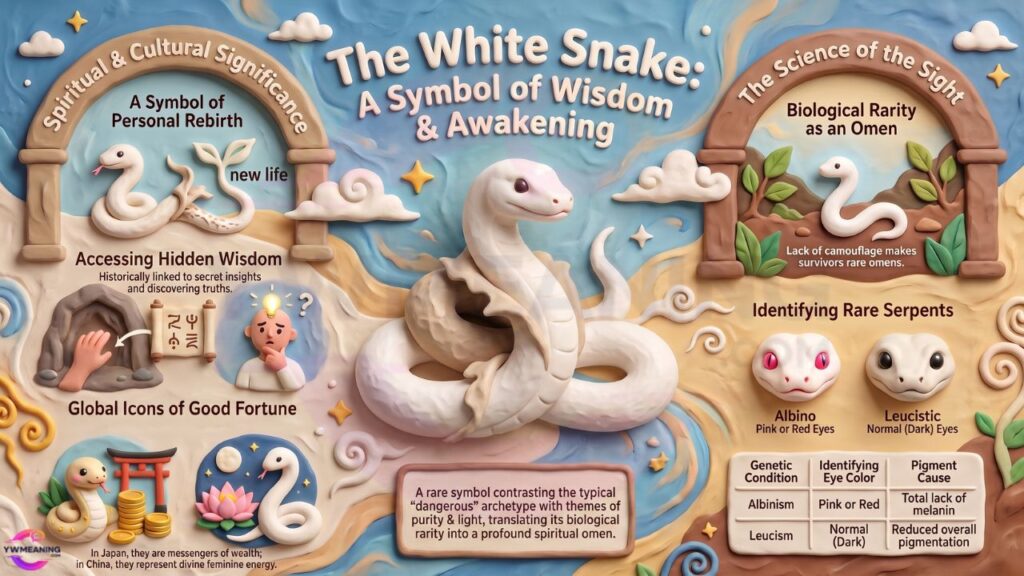

If you’ve ever spotted a white snake slithering across your path or woken up from a dream about one you probably went straight to Google wondering what it actually means. And honestly, that’s a fair reaction. White snake meaning touches on everything from ancient mythology to modern tattoo culture, and the symbolism runs a lot deeper than most people expect.
In this guide we’re going to unpack the full picture: the spiritual significance, the historical roots, the cultural variations, and yeah, even the science behind why some snakes are white in the first place.
Snakes already carry a lot of symbolic weight on their own. Add the color white into the mix, and you get a creature that feels almost otherworldly. So let’s get into it.
What Is a White Snake Symbol?
A white snake symbol combines two powerful ideas the snake, which represents transformation and hidden knowledge, and the color white, which signals purity, clarity, and spiritual light. Together, they form one of the more striking symbols in folklore and spirituality.
Most snakes you’ll come across are darker in tone, which honestly makes sense camouflage helps them survive. So when a white one shows up, it stands out immediately, almost like it wasn’t meant to blend in with the rest of nature. That rarity is a big part of why people treat white snakes as omens or spiritual signs instead of just, you know, an animal that happened to cross their yard.
Visual Characteristics of White Snakes
White snakes actually show up in several different forms, and not all of them mean the exact same thing symbolically:
- Pure white scales that resemble snow or ivory
- Albino snakes with pink eyes and pale, almost translucent skin
- Light cream or pearl-toned serpents
- White snakes depicted in art, tattoos, or spiritual imagery
- Mythical serpents said to glow with white light
Why Color Matters in Snake Symbolism
Color changes everything when it comes to animal symbolism, and white is no exception.
White represents purity, innocence, and spiritual light. It can also point to truth, clarity, or a sense of divine presence. When you pair that with a snake an animal that usually gets tied to danger or deception something interesting happens: the “danger” meaning softens quite a bit. Instead of fear, a white snake tends to suggest wisdom that’s emerging out of darkness, which is honestly a much more hopeful read than what snakes usually get.
Historical Origins of White Snake Symbolism
Snake symbolism goes back to some of the oldest mythologies on record, and white snakes specifically tend to show up in stories about knowledge, magic, and sacred wisdom. These older myths shaped a lot of how we interpret the symbol today, whether we realize it or not.
Ancient Symbolic Roots
In early traditions, serpents were seen as a stand-in for powerful natural forces. A few themes kept repeating across cultures:
- Transformation through shedding skin
- The cycle of life, death, and rebirth
- Hidden knowledge or sacred mysteries
- Earth energy and fertility
Because snakes disappear underground and then reappear later, ancient people naturally linked them to hidden realms of knowledge — like the snake had access to something the rest of us didn’t.
Medieval European Legends
European folklore has quite a few stories built around white snakes. One of the more famous ones tells of a king who eats a white snake and suddenly gains the ability to understand the language of animals. It’s a strange little tale, but the underlying message is clear: white snakes carry secret wisdom or supernatural insight that ordinary creatures don’t have access to.
A few themes carry through these old legends:
- Knowledge gained through curiosity
- Magical transformation
- Enlightenment that comes after discovery
These ideas still shape how people think about the symbol now, even if most folks have never heard the original story.
Spiritual Meaning of White Snake Symbolism
The white snake’s spiritual meaning centers on awakening, inner transformation, and the release of old patterns. It’s become a fairly common image in meditation art and dream interpretation circles, and for good reason — it captures that idea of enlightenment rising out of struggle pretty well.
Spiritual Interpretations
People commonly connect white snake symbolism to:
- Awakening of inner wisdom
- Personal transformation and healing
- A stronger connection to intuition and insight
- Release from old patterns or long-held fears
- The beginning of a new stage in life
Because snakes physically shed their skin, they naturally became a symbol for renewal — it’s kind of the perfect metaphor, honestly, an animal that literally sheds its old self and walks (well, slithers) away from it.
Symbol of Hidden Wisdom
White snakes often represent the kind of knowledge that only shows up after some real reflection — not the instant kind of insight, but the slow-earned kind. This can look like:
- Discovering the truth after a period of confusion
- Learning something valuable from difficult life experiences
- Becoming aware of talents you didn’t know you had
- Gaining a clearer sense of spiritual direction
This interpretation lines up really well with the modern self-growth movement, which is probably why the symbol has had such a resurgence lately.
White Snake Meaning in the United States
In American culture, white snake symbolism tends to blend ancient mythology with more modern ideas from psychology and self-help. It’s less about strict religious meaning and more about personal transformation.
Modern American Associations
People in the US commonly read the white snake as a sign of:
- Personal transformation after a hard season of life
- Spiritual awareness and mindfulness
- Intuitive insight and emotional clarity
- Rebirth, or just a genuine fresh start
- Protection during big life changes
These interpretations pop up a lot in online spaces — dream forums, meditation communities, tattoo subreddits, that kind of thing.
Symbol in Contemporary Culture
The white snake shows up in quite a few modern contexts too:
- Spiritual art and meditation imagery
- Tattoo symbolism representing rebirth
- Fantasy films and literature
- Nature photography that highlights rare animal encounters
The symbol manages to feel both ancient and current at the same time, which is part of what keeps it interesting.
Cross-Cultural Meanings of the White Snake
While American interpretations lean heavily on personal growth, plenty of other cultures attach much deeper mythological weight to white serpents. Understanding these traditions really helps explain why the symbol has such staying power globally.
East Asian Traditions
In Chinese folklore, the Legend of the White Snake tells a well-known romantic and spiritual story about a white snake spirit who transforms into a woman and falls in love with a mortal man. It’s one of China’s four great folktales, and it’s been retold in operas, films, and TV series for generations.
The Legend of the White Snake → represents → divine feminine energy and spiritual evolution. Common themes in the story include:
- Transformation between human and spirit forms
- Love overcoming supernatural barriers
- Wisdom paired with compassion
Other Cultural Interpretations
White serpents show up across a lot of different traditions, not just Chinese folklore:
- Japanese folklore often associates white snakes with good fortune, and in some Shinto beliefs, they’re considered messengers of Benzaiten, a goddess linked to wealth and wisdom
- Certain Native American stories connect white animals in general with sacred messages or important warnings from the spirit world
- Hindu symbolism ties serpents (nagas) to spiritual energy, protection, and the flow of life force, though white coloring specifically isn’t always emphasized the way it is in East Asian traditions
Despite these cultural differences, one thing stays pretty consistent — most interpretations lean toward wisdom and transformation rather than fear.
Emotional and Psychological Associations
Symbols shape how we process emotions, whether we’re consciously aware of it or not. The white snake carries a fair amount of psychological weight, and instead of triggering fear, it usually points toward awakening and clarity.
Emotional Meanings
People often associate a white snake encounter with:
- Renewal after some kind of emotional struggle
- A sense of calm awareness and reflection
- Curiosity about hidden truths
- The courage needed to embrace real change
These readings track with a broader cultural interest in self-discovery that’s honestly been building for years now.
Archetypal Meaning
From a psychological lens, the white snake can represent:
- Transformation of the inner self
- Awareness rising up from the subconscious
- Acceptance of change and personal growth
Since snakes shed their skin as a normal part of life, they’ve become a near-universal symbol for personal evolution — it’s hard to find a more fitting metaphor in the animal kingdom, really.
White Snake Symbolism in Dreams
A white snake in a dream typically symbolizes spiritual awakening, emotional healing, or a truth that’s becoming clear to you. This differs pretty noticeably from dreaming about a dark or aggressive snake, which usually points to fear, betrayal, or unresolved conflict.
Common Dream Interpretations
Dreaming about a white snake may suggest:
- Spiritual awakening or a fresh burst of insight
- A truth finally becoming clear after a period of confusion
- Emotional healing or renewal taking place
- Guidance coming from your own intuition
That said, dream meaning always depends on context — there’s no one-size-fits-all answer here.
Context Matters
A few things can shift the interpretation of the dream:
- Whether the snake felt friendly or threatening in the dream
- Your emotional state at the time
- Your cultural background and personal beliefs around snakes
So symbolism should really be treated as guidance, not some kind of fixed prediction about your future.
Modern Uses: Tattoos, Art, and Personal Identity
Symbols tend to survive because people keep using them in everyday life, and the white snake is a good example of that. It shows up constantly in modern design and personal expression.
Tattoo Symbolism
White snake tattoos usually represent:
- Personal transformation
- Spiritual awakening
- Wisdom earned through hard-won life experience
- Overcoming past struggles
Tattoo artists often pair the snake with other symbolic elements to round out the meaning.
Popular Visual Themes
Modern white snake imagery frequently includes:
- Moon symbolism paired with night scenes
- Lotus flowers, which represent spiritual growth
- Circles that stand for cycles and rebirth
- Coiled serpents symbolizing balance
These design choices tend to reinforce the same core ideas — renewal and personal evolution.
The Science Behind White Snakes: Albinism vs. Leucism
Before we go further into symbolism, it’s worth pausing on the biology, because most articles on this topic skip right past it. Not all white snakes are actually albino — there are a couple of distinct genetic conditions at play, and knowing the difference actually adds a layer of understanding to the symbolism itself.
| Condition | Cause | Key Traits | Eye Color |
|---|---|---|---|
| Albinism | Lack of melanin pigment (tyrosinase deficiency) | White or pale yellow skin | Pink or red |
| Leucism | Reduced pigmentation overall, but not melanin-specific | White, patchy, or pale skin | Normal (dark) |
| Xanthochromism | Excess yellow pigment, lack of other colors | Yellowish-white tone | Usually normal |
Albino snakes → lack → melanin production, which is what causes both the pale skin and the reddish or pink eyes you’ll often see in photos. Leucistic snakes, on the other hand, still produce melanin in their eyes — that’s actually the easiest way to tell the two conditions apart at a glance, since leucistic snakes usually keep their normal dark eye color.
Both conditions are genetic, and they occur in the wild as well as in captive breeding programs (ball pythons, for instance, are famously bred for these color morphs). Interestingly, in nature, a true albino or leucistic snake has a much harder time surviving — the lack of camouflage makes it an easy target for predators, which is probably part of why encountering one in the wild feels so rare and, to a lot of people, meaningful. It’s not just symbolic rarity; it’s biological rarity too.
White Snake Symbolism Over Time
Symbolic meanings rarely stay fixed for long, and the white snake is no exception. Over the centuries, its meaning has drifted from pure mythology toward something closer to modern psychology.
Historical Changes
The symbol has moved through a few distinct phases:
- Ancient myth: sacred knowledge and magic
- Medieval folklore: secret wisdom and transformation
- Modern spirituality: personal awakening and healing
Each era added its own layer of meaning on top of what came before.
Why Symbols Evolve
Symbol meanings shift for a few reasons:
- Cultural beliefs change generation to generation
- Media and pop culture spread new interpretations quickly
- Personal identity has become more central to how people read symbols today
As a result, the white snake stays a pretty flexible symbol — it bends to fit whatever era it’s being interpreted in.
Misunderstandings and Controversies
Snake symbolism causes a lot of confusion because, in most other contexts, snakes represent danger. White snakes, though, typically carry positive interpretations — the color shift really does change the read.
Common Misinterpretations
Some people mistakenly assume the symbol means:
- Danger or betrayal
- Evil or deception
- Fear or some hidden threat
These readings usually come from general snake symbolism, not from the white snake specifically, so it’s a bit of a mix-up worth clearing up.
Context Is Important
Interpretation ultimately depends on:
- Cultural tradition
- Personal belief
- The specific context the symbol shows up in
So the same white snake symbol really can mean different things to different people, and that’s okay — symbolism was never meant to be one-size-fits-all anyway.
Frequently Asked Questions
What does a white snake symbolize spiritually?
A white snake often symbolizes spiritual awakening, wisdom, and transformation — many view it as a sign of inner growth and clarity.
Is seeing a white snake considered lucky?
In several traditions, white snakes represent good fortune or divine protection, though meanings vary by culture and belief system.
What does dreaming of a white snake mean?
Dreaming of a white snake usually suggests insight, healing, or spiritual awareness, often tied to personal transformation.
Why are white snakes associated with wisdom?
Many myths describe white snakes as magical creatures linked to secret knowledge, and those old stories still shape today’s meaning.
Are white snake tattoos popular?
Yes — white snake tattoos commonly represent rebirth, personal change, and spiritual awareness, often paired with lotus or moon imagery.
What’s the difference between an albino and a leucistic white snake?
Albino snakes lack melanin and have pink or red eyes; leucistic snakes keep normal dark eyes despite pale or white skin.
What does the Legend of the White Snake mean in Chinese culture?
It’s a famous folktale symbolizing divine feminine energy, transformation, and love overcoming supernatural barriers between two worlds.
Keep Exploring:-
https://ywmeaning.com/dsl-meaning/
https://ywmeaning.com/istg-meaning-in-text/
https://ywmeaning.com/iirc-meaning/
https://ywmeaning.com/spiritual-meaning-of-a-dead-frog/