
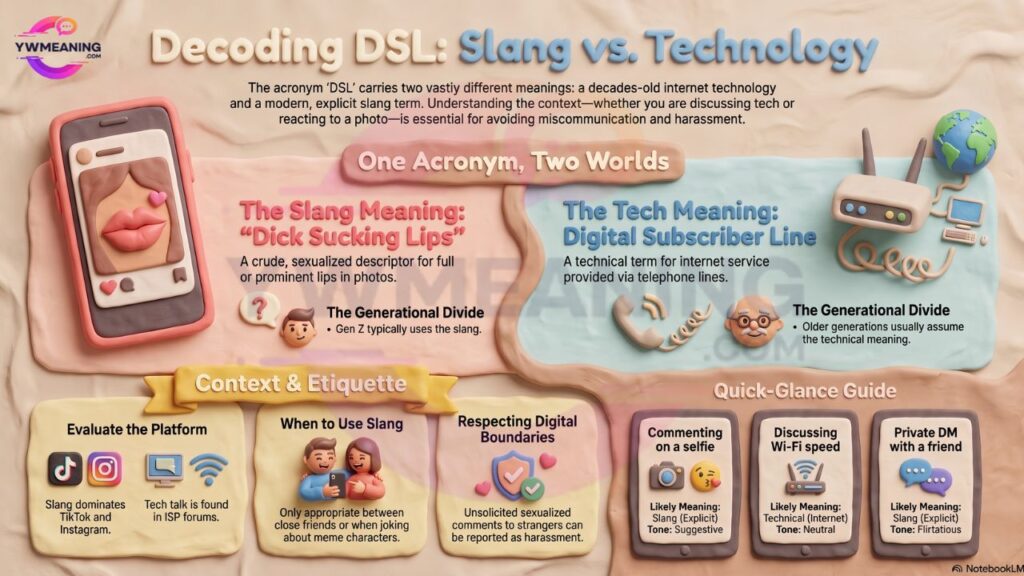

If you’ve ever seen someone comment “DSL” under a photo and had absolutely no clue what they were on about, you’re honestly not alone. It’s one of those internet abbreviations that pops up in a comment section, in a group chat, or under a TikTok, and unless somebody’s told you before, there’s really no way to just guess it.
This guide breaks down the real DSL meaning slang carries online, where it came from, and maybe more importantly how to read the tone and decide what to do if you come across it.
Understanding texting slang like this matters because a lot of digital miscommunication happens simply because one person knows a term and the other doesn’t. So let’s actually clear it up.
Quick Answer Box
| Detail | Info |
|---|---|
| Abbreviation | DSL |
| Most Common Meaning | “Dick Sucking Lips” (a crude, sexualized slang descriptor) |
| Other Meaning | Digital Subscriber Line (technical, internet-service term) |
| Typical Tone | Suggestive, teasing, sometimes crude |
| Commonly Seen On | TikTok, Snapchat, Instagram, texting, Discord |
| Safe For Work | Generally no |
| Quick Tip | Context and platform usually tell you which meaning is intended |
What Does DSL Mean In Text?
DSL, in slang form, stands for “Dick Sucking Lips.”
Yeah, it’s blunt, and honestly it’s part of why the abbreviation exists in the first place writing three letters feels a lot less explicit than writing the full phrase out. In internet culture, it’s used as a descriptive (and pretty sexualized) term for lips that appear full, prominent, or in the eyes of whoever’s typing it attractive in a suggestive way.
Linguistically it functions kind of like visual slang: it’s describing someone’s physical appearance while carrying a sexual undertone at the same time. It shows up most often as a reaction to photos, videos, or selfies, and it’s almost always tied to how someone looks in that specific image rather than being a general personality comment.
The semantic core of the term really comes down to two things layered together a physical description, plus a sexual implication. That combo is exactly why it can land totally differently depending on who says it, who it’s said to, and where.
Where Did DSL Come From? Origin And Evolution
DSL slang has roots going back to early-2000s internet forums and hip-hop-influenced online culture, well before TikTok or Instagram were even a thing. Back then it circulated mostly in comment sections and forum threads describing people with full lips.
As social media platforms grew especially ones built around photos and short video, like Instagram and later TikTok the term spread a lot faster and got baked into meme culture. It went from being a fairly niche bit of slang to something a huge chunk of internet users at least recognize, even if they don’t use it themselves.
That said, because of its explicit undertone, DSL never really made the jump into “polite” or public-facing language. It stuck around mostly in casual, informal, sometimes adult-leaning conversations online.
The Other DSL: Digital Subscriber Line
This is honestly where a lot of confusion happens, especially across generations. Digital Subscriber Line (DSL) is a totally unrelated technical term referring to a type of internet connection that runs over telephone lines.
If someone’s talking about their internet provider, router setup, or connection speeds, “DSL” almost certainly means the technology, not the slang. Example:
“Our house still runs on DSL internet, it’s honestly kind of slow.”
Older internet users, or anyone outside of meme-heavy platforms, are way more likely to assume this is the meaning being used which is exactly why context matters so much here.
How To Tell The Two Meanings Apart
Honestly it’s not that hard once you know what to look for. Ask yourself:
- Is the conversation about internet, wifi, or tech? → Almost certainly Digital Subscriber Line.
- Is it a reaction to a photo, selfie, or video? → Almost certainly the slang meaning.
- What platform is it on? → TikTok/Instagram comment sections lean slang; forums about broadband or ISPs lean technical.
- Who’s saying it, and to who? → Close friends joking around vs. a stranger’s comment section changes how it should be read.
Psychological And Social Function Of DSL
Psychologically speaking, DSL tends to work as a kind of sexualized compliment or teasing remark a shortcut so someone doesn’t have to write out a whole sentence to say “I think your lips look good in this pic.” It’s shorthand, basically.
Among friend groups it can function as playful social signaling, a way of joking around that doesn’t feel that serious to the people involved. But because the underlying meaning is explicit, the exact same three letters can feel completely different even uncomfortable if it comes from someone the recipient doesn’t know well, or didn’t invite that kind of comment from.
This is really the emotional ambiguity at the heart of the term: it’s not that the meaning changes, it’s that the acceptability of it changes hugely based on relationship and consent to that kind of remark.
Communication Functions Of DSL
In practice, DSL tends to show up doing one of a few jobs in a conversation:
- Visual reaction language — reacting to how someone’s lips look in a specific photo or clip.
- Flirting shorthand — used between people who already have an established, comfortable rapport with suggestive humor.
- Meme or humor commentary — used jokingly, sometimes about a filter effect, an animated character, or an exaggerated expression rather than a real person at all.
These three functions explain why the same abbreviation can read as crude in one thread and completely harmless in another.
DSL Across Different Platforms
On TikTok, DSL usually shows up in comment sections reacting to videos or lip-sync content — sometimes tied to a filter that exaggerates someone’s features.
On Instagram, it tends to appear under photos where lips are a clear visual focus, often in comment threads.
On Snapchat, it typically shows up reacting to selfies or story posts, usually between people who already know each other.
In texting or DMs, it’s more likely to carry a direct flirting undertone since it’s a private, one-to-one context.
On Discord or gaming communities, it sometimes gets used humorously about avatars, character models, or animation rather than real photos at all.
Across all of these, capitalization doesn’t really change the meaning — writing it in all caps just tends to read as more blunt or emphatic.
Cultural And Generational Context
DSL slang is most recognized among Gen Z and younger Millennials, the demographic that grew up with meme culture, reaction videos, and comment-section humor as a normal part of daily communication.
Older users, understandably, are far more likely to assume the technical meaning first, simply because that’s the DSL they grew up hearing about (dial-up’s slightly-less-slow cousin, basically). This generational divide is a pretty good example of how internet language keeps recycling old abbreviations into brand new meanings.
Regionally, the slang usage is most common in English-speaking online spaces, particularly North American meme culture, though because platforms like TikTok are global, it’s spread well beyond that now.
When DSL Feels Okay vs. When It Doesn’t
This is honestly the section that matters most, and it’s the part a lot of slang explainers skip over.
It tends to land as harmless or playful when:
- It’s between close friends who already joke around in a similar tone with each other.
- Both people are comfortable with suggestive humor generally.
- It’s aimed at a meme, character, or filter rather than a specific real person.
It tends to land badly when:
- It’s said to a stranger, acquaintance, or someone in a professional context.
- It’s posted publicly under a photo where the person didn’t invite that kind of comment.
- There’s a power imbalance like an adult commenting this way to a much younger user, which is never appropriate regardless of platform or intent.
If you’re ever unsure, the safer move is a plain, non-sexualized compliment instead — something like “you have great lips” or just complimenting the photo overall communicates something similar without the explicit undertone.
What To Do If Someone Sends You DSL
If it’s from a friend and it feels in-line with how you two normally talk, you honestly don’t owe anyone a big reaction — a quick “lol” or “thanks I guess” usually covers it.
If it feels off, uninvited, or comes from someone you don’t have that kind of rapport with, it’s completely reasonable to set a boundary. Something like “I’d rather not get comments like that” or “let’s keep it respectful” gets the point across clearly without needing to escalate things.
Common Misunderstandings About DSL
Mixing it up with the technical term. As covered above, plenty of people — especially outside terminally-online circles — will assume DSL means the internet service, not the slang, and that’s a completely reasonable assumption depending on context.
Assuming it’s always a compliment. It isn’t. Tone, relationship, and setting all shape whether a comment like this reads as flattering or as disrespectful, and treating it as automatically positive misses that entirely.
Filling The Gap: Platform Moderation And Where The Line Actually Is
One thing that rarely gets addressed anywhere online: how platforms themselves treat comments like this. Sexually suggestive remarks directed at another user’s appearance can fall under harassment or sexual-content guidelines on platforms like Instagram, TikTok, and Discord, particularly when they’re unsolicited, repeated, or directed at a minor the last of which is treated as a serious safety violation everywhere, no exceptions.
Most platforms allow users to report comments they find inappropriate, and repeated unwanted sexualized comments can lead to warnings or account restrictions depending on the platform’s policy. If a comment like this is posted toward you and it doesn’t sit right, reporting it is a completely valid option you don’t have to just brush it off because “it’s just slang.”
Filling The Gap: How DSL Compares To Similar Slang
DSL isn’t the only appearance-based abbreviation floating around online — it exists in a small family of similar terms, though DSL is one of the more explicit ones. Compared to something like “thick lips,” which is a neutral, literal physical description, DSL adds a sexual layer on top of the description.
Compared to general compliments like “fine” or “sexy,” which express attraction broadly, DSL is narrower — it’s specifically about one feature. Understanding where a term sits on that spectrum (literal description → general compliment → explicit slang) can help you gauge how “loaded” a piece of slang really is before you decide whether it’s appropriate to use or respond to.
Quick Reference Table: DSL Meaning By Context
| Context | Likely Meaning | Typical Tone |
|---|---|---|
| Comment under a selfie/video | Slang (“Dick Sucking Lips”) | Suggestive/teasing |
| Tech or ISP conversation | Digital Subscriber Line | Neutral/technical |
| Gaming/Discord about a character | Slang, used humorously | Joking, non-serious |
| Private DM between close friends | Slang, often flirtatious | Casual/flirty |
| Public comment to a stranger | Slang | Risky — often reads as inappropriate |
Why This Kind Of Slang Keeps Spreading
It’s worth stepping back for a second and asking why abbreviations like this take off in the first place. Part of it is just how social media rewards quick reactions — nobody’s typing out a full paragraph under a fifteen-second video, so short, loaded terms fill that gap nicely.
Part of it is also that abbreviations feel a little less explicit than spelling the whole phrase out, which probably makes people more comfortable typing it in a public comment section than they’d otherwise be.
And part of it, honestly, is just how meme culture works generally — a term gets used once in a viral video or comment, other people pick it up because it’s funny or edgy, and within a few months it’s everywhere. None of that is unique to DSL specifically, but it does explain why slang like this spreads so much faster now than it would have a couple decades ago.
Final Thoughts
At the end of the day, the DSL meaning slang carries really comes down to context. It started as a fairly explicit descriptor for lips, spread through meme culture and short-form video platforms, and now shows up everywhere from TikTok comments to gaming servers — sometimes playful, sometimes a bit much depending on who’s saying it and to whom.
Knowing both meanings (the slang one and the Digital Subscriber Line one) means you won’t be caught off guard next time it shows up in your notifications, and knowing the etiquette around it means you can navigate it — whether you’re on the receiving end or just trying to figure out what on earth someone meant by three random letters.
Frequently Asked Questions
What does DSL mean in texting?
DSL usually means “Dick Sucking Lips,” a slang term describing lips seen as sexually attractive in photos or videos.
Does DSL have another meaning?
Yes — DSL also stands for Digital Subscriber Line, a technical term for a type of internet connection.
Is DSL slang offensive?
It can be, especially if said to someone who didn’t invite that kind of comment, like a stranger or coworker.
Is DSL appropriate for work or public use?
No, it’s generally not considered safe for professional or public settings due to its explicit meaning.
Why do people comment DSL under photos?
They’re usually reacting to how someone’s lips look, often meant as teasing or a suggestive compliment.
How do I know which DSL meaning is intended?
Check the context — tech conversations mean Digital Subscriber Line, photo reactions mean the slang version.
What should I do if I get an unwanted DSL comment?
You can set a boundary directly, or report it — platforms treat repeated unwanted sexual comments as harassment.