
You almost stepped on it. A little frog, still and lifeless, right there on your porch or maybe on the bathroom tile. Your first thought probably wasn’t “gross” it was “wait, does this mean something?” If you’ve been searching for the spiritual meaning of a dead frog, you’re definitely not alone, and honestly, the answer is a lot more layered than most people expect.
Across cultures and centuries, frogs have carried heavy symbolic weight fertility, rain, transformation, even warnings. So when one turns up dead, especially somewhere unexpected like your home, it’s natural to wonder if the universe is trying to tell you something.
This guide walks through what a dead frog can symbolize, where these beliefs came from, and what (if anything) you should actually do about it.
What Does a Dead Frog Symbolize?
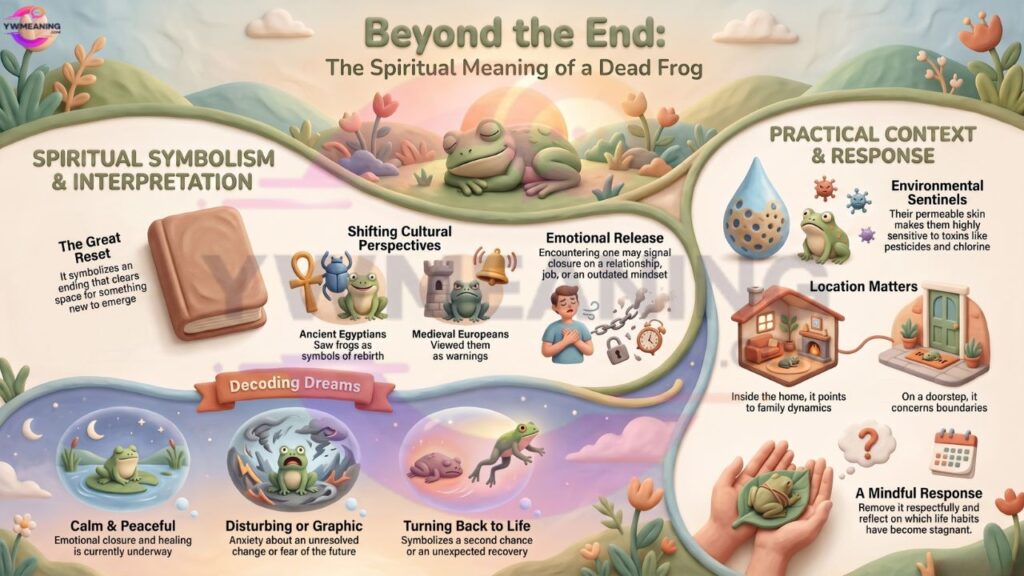
In most spiritual traditions, a dead frog symbolizes an ending that clears space for something new. It’s rarely interpreted as literal bad news — more like a nudge that a chapter of your life has run its course.
Because frogs live between two worlds (water and land), they’ve long been seen as creatures of transition and transformation. Death of that creature, symbolically speaking, flips the meaning from “change is coming” to “a change has already happened, or needs to.” Think of it less like a doom sign and more like a full stop at the end of a sentence — the sentence still mattered, it’s just done now.
Common interpretations include:
- Emotional release after a difficult period
- Closure on a relationship, job, or mindset that no longer fits
- A signal to let go of stagnant habits
- A reminder that growth often follows loss
Dead Frog Omen: Good Sign or Bad Sign?
Whether a dead frog omen is good or bad honestly depends who you ask, and that’s not me dodging the question — the traditions genuinely disagree. Older rural folklore, especially in parts of Europe, treated a dead frog as a warning of illness, bad weather, or misfortune on the way. That version of the belief comes mostly from a time when frogs (and toads) were lumped in with witchcraft and dark omens.
Modern spiritual interpretation, though, tends to go the opposite direction. Most contemporary readers frame it as neutral-to-positive — less “something bad is coming” and more “something old is leaving.” If you’re the type who gets spooked by these encounters, it might help to know that the majority of current spiritual writing treats it as an invitation to reflect, not a curse.
What Does a Dead Frog Mean Spiritually? A Deeper Look
So what does a dead frog mean spiritually once you go past the surface-level “change is coming” answer? A few layers tend to show up again and again in spiritual texts and folk belief:
- Stagnation warning — frogs move freely between water and land, so a dead one may represent being “stuck,” emotionally or spiritually frozen in place.
- Cleansing incomplete — since frogs are tied to water, their death can hint that emotional cleansing hasn’t fully happened yet.
- Sacrifice for growth — in several ancient belief systems, a death (even a small animal’s) marked the price of moving forward.
None of these are meant to be read literally, by the way. Spiritual symbolism works more like poetry than prophecy — it’s a lens, not a headline.
Historical and Cultural Roots of Frog Symbolism
To really understand the modern meaning, it helps to know where all this came from. The symbolism didn’t appear out of nowhere — it’s been building for thousands of years.
Ancient Egypt and the Goddess Heqet
Ancient Egypt → gave rise to → frog symbolism tied to fertility and rebirth. This connection wasn’t random — every year, the Nile flooded, and frogs seemed to appear out of nowhere along with the fertile silt that made crops grow. Naturally, people connected the two.
Heqet, an Egyptian goddess associated with childbirth and fertility, was depicted with the head of a frog. She was basically the ancient world’s way of saying “this animal equals new life,” which makes the modern “dead frog equals ending” interpretation feel like a mirror image of that older belief.
Greek, Roman, and Medieval European Views
Greek and Roman culture treated frogs a bit more playfully — think fables, comedy, seasonal stories about rain and harvests. But things got darker in the Middle Ages. Toads (often confused with frogs in old texts) got linked to witchcraft, poison, and the devil. In parts of medieval France, toad imagery was even carved at the base of church holy water basins, supposedly representing evil being “exorcised” by the blessed water.
That negative streak is honestly where a lot of the modern “bad omen” fear probably traces back to, even if most people don’t realize it.
Native American and Chinese Symbolism
Native American symbolism around frogs tends to focus on rain, cleansing, and communication with the natural world — though it’s worth being upfront that beliefs vary a lot between different tribes and nations, so there’s no single “Native American meaning” to point to.
Chinese symbolism, on the other hand, is pretty specific: the three-legged money frog is a well-known symbol of wealth and prosperity, often placed near a home’s entrance for good fortune. A dead frog in this tradition can flip that meaning, suggesting blocked luck or interrupted financial flow — which, fair warning, might make some readers a little uneasy if they just found one near their front door.
Dead Frog Biblical Meaning
The dead frog biblical meaning is one people search for a lot, probably because frogs show up in one of the more dramatic Old Testament stories. In Exodus, frogs were one of the plagues sent upon Egypt — an overwhelming, chaotic swarm meant as judgment. That’s given frogs a somewhat negative reputation in biblical symbolism, tied to impurity, excess, or chaos.
That said, most modern Christian interpretation doesn’t stop there. A lot of pastors and spiritual writers today frame animal deaths more broadly as symbols of renewal following hardship — echoing themes of resurrection and new life that run through the whole Bible. So while the plague imagery is real, it isn’t the only lens Christian readers apply anymore.
Spiritual Meaning of a Dead Frog in Your House
This is probably the version of the question that brought most people here, so let’s get into it properly. The spiritual meaning of a dead frog in the house is generally read as something happening close to home — literally and emotionally. Because your house represents your personal, private life, finding a dead frog inside is often interpreted as:
- A sign that something in your home life or family dynamic needs to shift
- A closing chapter tied to your living situation (moving, a relationship ending, a roommate leaving)
- A prompt to clear out clutter or stagnant energy, spiritually and literally
Practically speaking, frogs sometimes get into homes through gaps, drains, or damp basements — so there’s a mundane explanation too. But spiritually, the “why here, why now” question is what people are really asking about.
Brown Frog Inside the House Spiritual Meaning
Color matters in a lot of symbolic traditions, and brown frogs specifically get their own interpretation. A brown frog inside the house often gets linked to grounding and earthy stability rather than the more dramatic emotional symbolism tied to unusually colored frogs. Brown is an earth tone, so this variation is sometimes read as a nudge toward practical, grounded decision-making — less “big spiritual upheaval,” more “get your feet back on solid ground.”
Frog Inside the House Spiritual Meaning Love
When it comes to relationships, a frog inside the house spiritual meaning love angle usually centers on transformation within a partnership. People going through relationship changes — a breakup, reconciliation, or a shift in commitment — sometimes report frog encounters right around that time, and interpret it as confirmation that the relationship is entering a new phase. A dead frog in this context can suggest an old relationship pattern (not necessarily the relationship itself) is ending.
Spiritual Meaning of a Dead Frog in Dream
Dream symbolism is honestly where a huge chunk of this search traffic comes from, and it makes sense — dreams feel personal and mysterious in a way waking encounters don’t always match. The spiritual meaning of a dead frog in dream context usually points to:
| Dream Scenario | Common Interpretation |
|---|---|
| Calm, peaceful dead frog dream | Emotional closure, acceptance, healing underway |
| Disturbing or graphic dead frog dream | Anxiety about an unresolved change or fear |
| Dreaming of finding many dead frogs | Overwhelm, or multiple endings happening at once |
| Dead frog turning back to life in dream | Renewal, a second chance, or unexpected recovery |
Most dream analysts agree context is everything here. The emotional tone of the dream — were you scared, sad, indifferent, relieved — usually tells you more than the frog itself does.
Seeing a Dead Frog Meaning: What to Pay Attention To
Seeing a dead frog meaning shifts quite a bit depending on where and how you encounter it. Location matters more than people give it credit for:
- On your doorstep — often read as a message specifically about your home or personal boundaries
- On the road — tied to travel, decisions, or a “path” you’re on
- Near water — points back to emotional cleansing themes, since water is the frog’s natural symbolic territory
- In your garden — can relate to growth projects, work, or things you’re “cultivating” in life
Spiritual Meaning of a Frog Jumping on You at Night
This one’s a bit different since it’s about a living frog rather than a dead one, but it comes up so often alongside dead frog searches that it’s worth covering. The spiritual meaning of a frog jumping on you at night is generally interpreted as a sudden, unavoidable prompt toward change — nighttime symbolism often ties to the subconscious, intuition, or things you’ve been avoiding facing head-on. A frog literally jumping onto you (rather than just being nearby) tends to be read as a more urgent version of the usual transformation message — basically the universe skipping the subtle hints and going straight for your attention.
Dead Toad Meaning: How It Differs From a Dead Frog
People use “frog” and “toad” pretty interchangeably in everyday conversation, but spiritually they’ve historically carried different weight. Dead toad meaning leans more heavily into the darker medieval associations mentioned earlier — witchcraft, poison, and ill omens — largely because toads were seen as uglier, warty, and “more dangerous looking” even though most are harmless.
That said, modern interpretation has softened this distinction a lot. Many contemporary spiritual writers treat frogs and toads almost the same way, focusing on transformation and endings rather than the older toad-specific fear. Still, if you’re going deep into folklore-based interpretation rather than modern spiritual writing, it’s worth knowing the toad version tends to skew a bit more cautionary.
The Science Behind Dead Frogs (The Gap Most Guides Skip)
Here’s something a lot of spiritual guides gloss right over: why do frogs actually die so easily, and so often near human homes? Understanding the biology behind it doesn’t cancel out the symbolism — honestly it kind of deepens it, because it explains why this experience is so common in the first place.
Frogs have permeable skin, meaning they absorb water (and chemicals) directly through it rather than drinking. That makes them incredibly sensitive to:
- Pesticides and lawn chemicals, even in small amounts
- Chlorine from pools or treated water
- Temperature shock, especially sudden cold snaps
- Chytrid fungus, a disease that’s caused mass amphibian die-offs worldwide over the past few decades
- Dehydration, if they end up trapped indoors away from moisture
This is also why frogs are treated as environmental indicators — scientists literally use amphibian population health as an early warning system for ecosystem problems, since frogs tend to show damage from pollution long before it’s obvious anywhere else. So in a weird way, the “spiritual warning” interpretation and the scientific one actually line up more than you’d think — a dead frog really can be a sign that something in the environment needs attention.
What to Do When You Find a Dead Frog (Practical Steps)
Knowing the symbolism is one thing, but a lot of people land on this page wanting to know what they should actually do next. Here’s a simple approach that blends the practical and the spiritual:
- Remove it respectfully. Use gloves or a bag, and if it feels meaningful to you, a small moment of acknowledgment (even just a quiet “thank you”) isn’t a bad idea.
- Check for a cause. If it’s near a drain, chemical-treated lawn, or pool, that’s probably your practical answer — and worth addressing so it doesn’t happen again.
- Journal the moment. What was going on in your life right then? Spiritual symbolism tends to land better when you connect it to something real happening around it.
- Sit with the “ending” theme. Ask yourself honestly if there’s something you’ve been avoiding closing out — a habit, a relationship, a mindset.
- Don’t panic over “bad luck.” Most modern interpretation, across nearly every tradition covered here, leans toward renewal rather than doom.
Modern and Pop Culture Symbolism
Frog symbolism hasn’t stayed frozen in ancient texts — it’s very much alive online too. Through the 2020s, frogs became a genuine internet aesthetic, tied to cottagecore, comfort, and a kind of gentle nature-appreciation vibe among younger users. That’s a pretty different energy from the political frog-meme confusion that spread online during the 2010s, and honestly, it’s worth separating those two things because they get mixed up a lot in casual conversation.
Tattoos are another modern angle — people don’t usually get a dead frog tattoo lightly. When they do, it’s almost always tied to surviving something hard: leaving a toxic situation, recovering from loss, or marking a transformation they don’t want to forget.
Final Thoughts
At the end of the day, the spiritual meaning of a dead frog isn’t really about fear — most traditions, once you dig past the scarier medieval folklore, land somewhere near renewal, closure, and growth. Whether you found it in your house, your garden, or in a dream, the recurring theme is pretty consistent: something is ending so something else has room to begin. Combine that with the very real biological reasons frogs die where they do, and the whole experience starts to feel less like a spooky omen and more like a genuine invitation to pay attention — to your environment, and maybe to yourself too.
Frequently Asked Questions
What does a dead frog symbolize?
A dead frog usually symbolizes endings, emotional release, and transformation — a sign that one phase of life is closing.
Is a dead frog a bad omen?
Older folklore treated it as a warning, but modern interpretations mostly see it as neutral or a positive sign of renewal.
What does it mean to find a dead frog in your house?
It often points to changes needed within your home life, personal space, or family dynamics rather than anything outside.
What does a dead frog mean in a dream?
It typically reflects emotional exhaustion or unresolved change, though the dream’s tone shapes whether it feels negative or peaceful.
Is there a biblical meaning behind a dead frog?
Frogs appear negatively in Exodus as a plague, but modern Christian interpretation leans toward renewal after hardship.
What’s the difference between dead frog and dead toad symbolism?
Toads historically carry darker, witchcraft-linked meanings, while frogs lean more toward transformation and growth themes.
Why do frogs die so often near homes?
Their permeable skin absorbs chemicals like pesticides and chlorine easily, making them highly vulnerable to nearby pollutants.