
Have you ever received a message that simply said “ION know” or “ION care” and wondered what it meant? You’re not alone. The phrase ION meaning in text has become one of the most searched internet slang terms because it’s used everywhere from Snapchat and TikTok to Instagram, WhatsApp, Discord, and even regular text messages.
At first glance, it looks confusing, but once you understand the context, it becomes surprisingly easy to read.
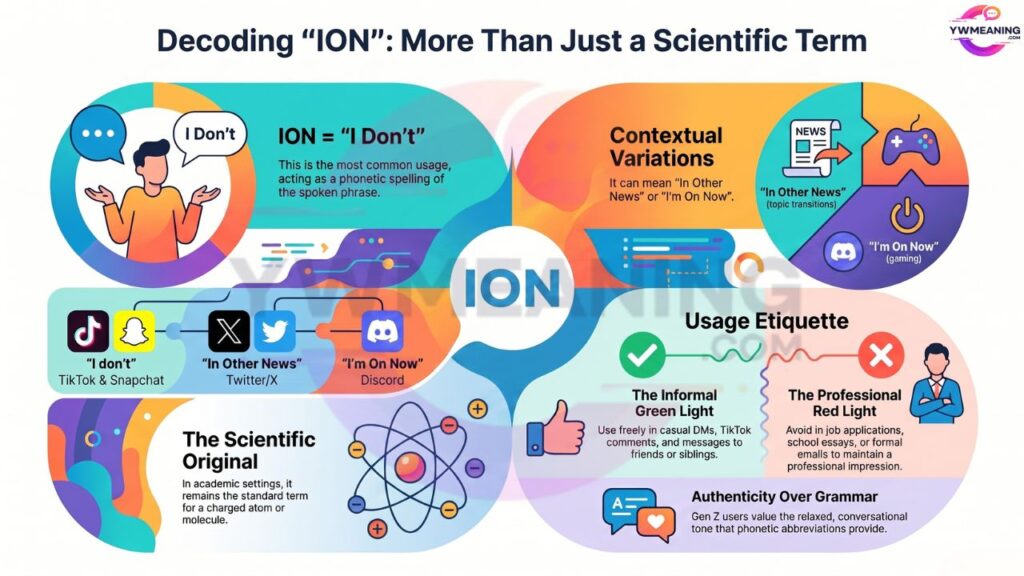
In most online conversations, ION simply means “I don’t.” It’s a shortened, phonetic version of the phrase that reflects how many people naturally pronounce the words when speaking quickly. Still, that’s not the only meaning.
Depending on where you see it, ION can also stand for “In Other News,” refer to a charged atom in chemistry, or even mean “I’m On Now” in gaming chats. So yeah, context matters a lot.
This guide explains what ion mean, how people use it across different social media platforms, when you should avoid using it, and why it has become one of the most recognizable pieces of Gen Z texting slang in 2026.
What Does ION Mean in Text?
Direct Answer: In texting, ION usually means “I don’t.” It’s an informal abbreviation people use to type faster during casual conversations.
The expression isn’t actually an acronym in the traditional sense. Instead, it’s a phonetic spelling. When many English speakers say “I don’t” quickly, it often sounds like “ion.” Over time, that pronunciation made its way into online messaging, where speed and convenience matter more than perfect grammar.
Because of that, you’ll regularly find ion meaning text discussions on social media. Teenagers, young adults, gamers, and content creators all use it naturally in chats without thinking twice. It saves a few keystrokes, and honestly, it feels more conversational.
Here are a few common examples:
- ION know what happened.
- ION think that’s true.
- ION wanna leave yet.
- ION care about the drama.
- ION remember seeing that.
The relationship is simple:
ION → means → “I don’t.”
Search engines recognize this direct semantic relationship because it’s the most common interpretation across texting platforms.
Why Has ION Become So Popular?
The biggest reason is speed. Modern messaging is built around quick replies, short expressions, and conversational typing. People naturally shorten words that everyone already understands.
Several factors helped ION spread across the internet:
- Fast mobile typing
- Casual conversations
- Gen Z internet culture
- Viral TikTok comments
- Snapchat streaks
- Instagram DMs
- Discord gaming chats
- Meme culture
Unlike traditional abbreviations such as IDK, IDC, or TBH, ION doesn’t look like initials. That’s why many people become confused the first time they see it.
Another reason it’s popular is that it sounds exactly like natural speech. Rather than typing “I don’t know,” someone simply writes:
ION know.
It feels relaxed, informal, and authentic.
What Does ION Mean on Snapchat?
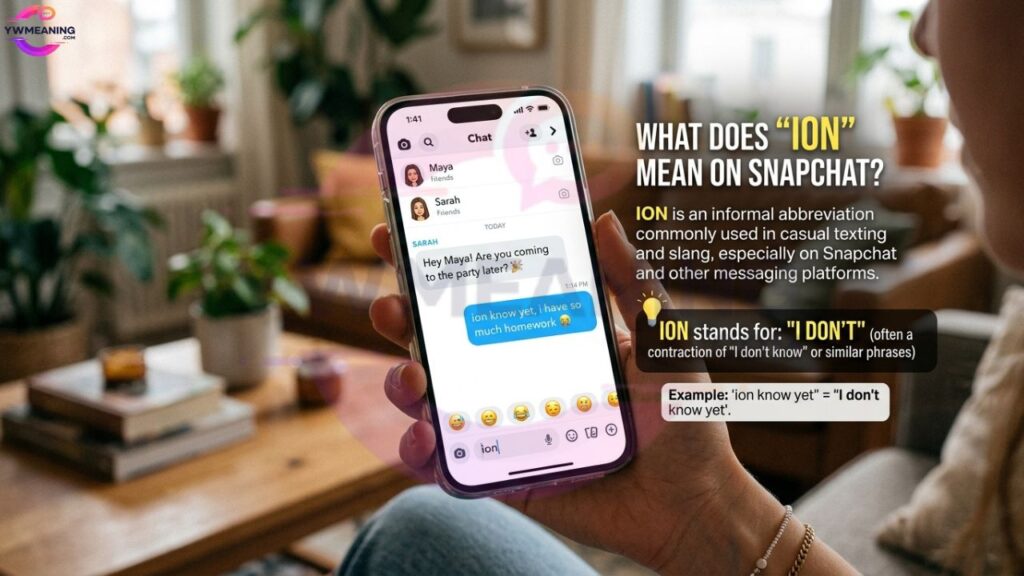
Direct Answer: What does ion mean Snapchat? On Snapchat, ION almost always means “I don’t.”
Snapchat conversations are usually quick, informal, and filled with abbreviations. Since disappearing messages encourage short replies, users naturally remove unnecessary letters while texting. That’s one reason what does ion mean snapchat is searched so often.
You’ll commonly see messages like:
- ION know 😂
- ION wanna lose our streak.
- ION think she’s online.
- ION remember sending that.
Most Snapchat users immediately understand the phrase because it has become part of everyday texting abbreviations.
Common Snapchat Examples
| Snapchat Message | Meaning |
|---|---|
| ION know | I don’t know |
| ION care | I don’t care |
| ION want it | I don’t want it |
| ION think so | I don’t think so |
| ION remember | I don’t remember |
Although Snapchat slang changes quickly, ION has remained popular because it’s simple, natural, and easy to recognize.
What Does ION Mean in Text on Instagram?
Direct Answer: What does ion mean in text on Instagram? In Instagram DMs, captions, and comments, ION generally means “I don’t.”
Instagram has evolved from a photo-sharing app into a messaging platform where slang spreads incredibly fast. Users frequently type exactly how they speak, which explains why what does ion mean in text on instagram has become a common search query.
You might read comments such as:
- ION like this trend.
- ION think that’s real.
- ION wanna argue today.
- ION believe everything online.
Sometimes creators also use ION to create a casual tone that feels more relatable to followers.
For example:
ION expected this video to go viral 😭
The sentence feels conversational rather than formal, which matches Instagram’s communication style.
What Does ION Mean in Text From a Girl?
Direct Answer: What does ion mean in text from a girl? Usually, it still means “I don’t.” The meaning doesn’t change because of the sender’s gender.
People often assume slang has hidden emotional meanings when a crush or romantic interest uses it. Most of the time, though, that’s overthinking things a little.
If a girl texts:
ION feel like going out today.
She’s probably just saying:
I don’t feel like going out today.
Likewise:
- ION know.
- ION wanna fight.
- ION think that’s funny.
- ION remember.
The emotional tone depends on the entire conversation—not the word ION itself.
That said, context can slightly change the feeling behind the message.
For example:
ION care anymore.
This may sound frustrated.
Meanwhile:
ION know lol 😂
Sounds relaxed and playful.
Understanding conversation context is always more important than focusing on a single abbreviation.
ION Meaning in WhatsApp
Direct Answer: ION meaning in WhatsApp is almost always “I don’t.”
WhatsApp conversations often resemble normal texting between family members, classmates, coworkers, and close friends. Younger users especially enjoy shortening common phrases.
Typical WhatsApp messages include:
- ION know where he went.
- ION think Mom’s home.
- ION wanna call right now.
- ION have enough time.
Unlike work emails or business chats, WhatsApp encourages informal communication, making abbreviations like ION, IDK, IDC, FS, and ONG feel completely normal.
However, if you’re chatting with a client, teacher, or someone unfamiliar with internet slang, writing the full phrase “I don’t” is usually a smarter choice.
ION Meaning Slang on TikTok
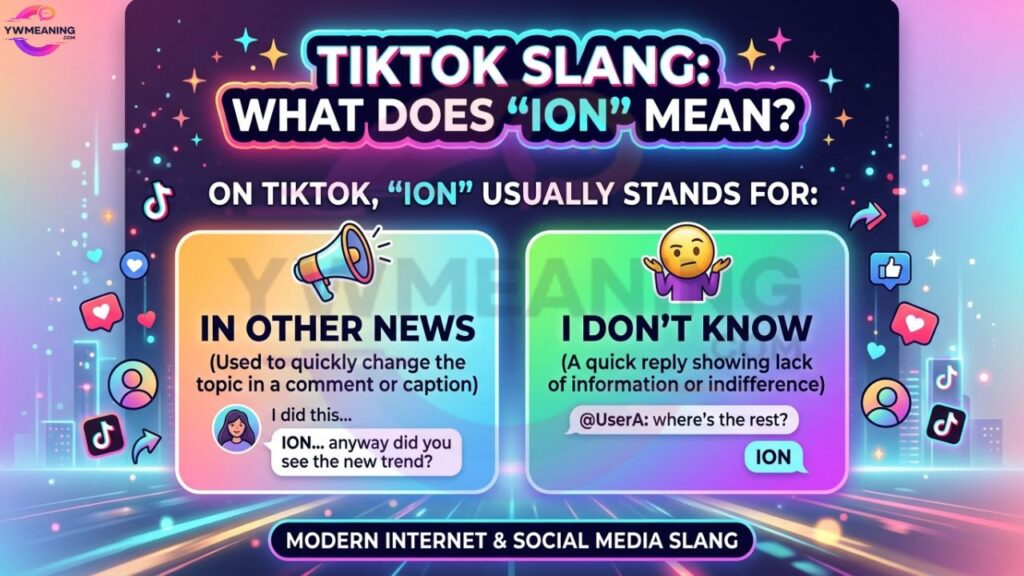
Direct Answer: ION meaning slang TikTok almost always translates to “I don’t.”
TikTok has become one of the biggest sources of modern internet slang. Viral creators, comment sections, livestreams, and memes constantly introduce new expressions that quickly spread across other social media platforms.
Examples include:
- ION trust anybody 😭
- ION understand this challenge.
- ION know why this is funny.
- ION expected this ending.
TikTok users value authenticity more than perfect grammar. Because of that, phonetic spellings like ION, finna, tryna, and gon appear naturally throughout comments.
This trend has helped Gen Z slang become part of everyday digital communication.
ION Slang Pronunciation
Many people know how to type it but aren’t sure how to say it aloud.
ION slang pronunciation is:
Eye-on
Although it’s pronounced like the English word ion, remember that in texting it usually represents “I don’t.”
Here’s an easy comparison:
| Written | Spoken |
|---|---|
| I don’t know | Eye-on know |
| I don’t care | Eye-on care |
| I don’t want it | Eye-on want it |
That’s why many linguists describe ION as a phonetic abbreviation rather than a traditional acronym.
It mirrors natural speech instead of standing for separate words.
ION Meaning According to Urban Slang
If you’ve searched ION meaning Urban Dictionary, you’ve probably noticed that most definitions point toward the same explanation.
Across internet slang communities, ION overwhelmingly means:
I don’t
The popularity of this spelling grew from online forums, social media platforms, texting culture, and spoken English. Instead of carefully writing every word, users simply typed what they heard.
This reflects a broader trend in digital communication, where speed often outweighs grammatical accuracy.
Other examples of phonetic internet slang include:
- Gonna
- Wanna
- Lemme
- Gimme
- Finna
- Tryna
- Ima
These expressions aren’t considered mistakes in casual chats—they’re simply part of modern online language.
Why Context Matters When Reading ION
Although ION usually means “I don’t,” you shouldn’t automatically assume that’s always correct.
The same three letters can have completely different meanings depending on the platform, topic, and surrounding conversation.
For example:
- ION know what happened. → I don’t
- ION… today’s weather is crazy. → In Other News
- Positive ion forms after losing electrons? → Chemistry
- ION, invite me to the lobby. → I’m On Now (gaming)
Other Meanings of ION You Should Know
Direct Answer: While ION meaning in text usually refers to “I don’t,” the same word can have several other meanings. The correct definition depends entirely on the conversation and platform.
This is where many people get confused. Someone might see ION in a tweet, a science class, or a gaming server and assume it always means “I don’t.” That isn’t always true. Reading the surrounding words helps you identify the right meaning within seconds.
1. ION = “I Don’t” (Most Common)
This is by far the most popular meaning across texting apps and social media.
Examples:
- ION know what happened.
- ION wanna go.
- ION think that’s true.
- ION remember that movie.
Semantic relationship:
ION → means → “I don’t.”
If you’re chatting with friends, this is almost certainly the intended meaning.
2. ION = “In Other News”
On platforms like Twitter/X and sometimes Instagram, ION may stand for “In Other News.”
People use it to change the subject or introduce a new topic.
Examples:
- ION… I finally passed my driving test.
- ION, who’s watching the game tonight?
- ION, this weather has been wild lately.
Here, ION → introduces → a new topic.
This usage is less common than “I don’t,” but you’ll still encounter it, especially in posts rather than private messages.
3. ION = Ion (Chemistry)
Outside social media, an ion is a completely different thing.
In chemistry, an ion is an atom or molecule that has gained or lost electrons, giving it an electrical charge.
Examples include:
- Sodium ion
- Chloride ion
- Positive ion (cation)
- Negative ion (anion)
Semantic relationship:
Ion → refers to → a charged atom or molecule.
If you’re reading a science textbook or attending chemistry class, this is almost certainly the intended meaning.
4. ION = “I’m On Now”
Although less common today, gamers occasionally use ION to mean:
I’m On Now
Examples:
- ION, send the invite.
- ION if you wanna squad up.
- ION, let’s play.
Gaming communities often create their own abbreviations, so meanings can vary between games and Discord servers.
How ION Evolved Into Internet Slang
One topic many articles barely explain is where ION actually came from.
The word didn’t suddenly appear on TikTok. It evolved over several years through spoken English, online messaging, and internet culture.
When people say “I don’t” quickly, the words often blend together. Instead of clearly pronouncing both words, many speakers naturally produce a sound close to “ion.” As texting became more conversational, users began typing exactly what they heard.
This style of writing became especially common in African American Vernacular English (AAVE), where spoken pronunciation has influenced internet language in many ways. From there, social media accelerated its popularity. Platforms such as Twitter/X, Snapchat, and later TikTok exposed millions of users to the spelling.
Eventually, creators, influencers, and everyday users adopted it as part of modern Gen Z slang. Today, it’s recognized across multiple messaging apps and social platforms, making it one of the most familiar examples of phonetic abbreviations online.
How to Identify the Correct Meaning of ION
If you’ve ever wondered why one person says ION means “I don’t” while another says it means “In Other News,” the answer is simple—context.
Ask yourself these questions:
- Is the conversation casual?
- Is someone replying directly to another message?
- Is the sentence expressing disagreement or uncertainty?
- Is the topic changing?
- Is the discussion about science or gaming?
A quick decision guide:
- Casual chat → I don’t
- Topic transition → In Other News
- Chemistry lesson → Charged atom
- Gaming lobby → I’m On Now
Reading the entire sentence before interpreting the abbreviation helps you avoid misunderstandings.
Platform Differences: Does ION Mean the Same Everywhere?
Not always. While “I don’t” remains the dominant meaning, usage varies slightly by platform.
| Platform | Most Common Meaning |
|---|---|
| Snapchat | I don’t |
| TikTok | I don’t |
| I don’t (occasionally “In Other News”) | |
| I don’t | |
| Discord | I don’t or I’m On Now |
| Twitter/X | I don’t or In Other News |
| iMessage | I don’t |
These differences aren’t strict rules, but they’re helpful guidelines based on common usage.
When Should You Use ION?
Like any slang term, ION works best in informal settings.
Use it when you’re:
- Texting close friends
- Chatting on Snapchat
- Commenting on TikTok
- Sending Instagram DMs
- Talking in Discord servers
- Messaging siblings or classmates
- Playing online games
Because everyone understands the relaxed tone, it feels natural in these situations.
When Should You Avoid Using ION?
There are times when writing the full phrase “I don’t” is the better option.
Avoid ION in:
- Job applications
- Professional emails
- Business communication
- School essays
- Academic reports
- Messages to teachers or professors
- Client conversations
- Legal or official documents
Formal writing values clarity. Someone unfamiliar with internet slang could misunderstand the abbreviation, which may leave an unprofessional impression.
Real Conversation Examples
Seeing ION in realistic conversations makes it much easier to understand.
Example 1: Friends
Alex: Wanna grab pizza?
Sam: ION feel like leaving the house.
Meaning:
I don’t feel like leaving the house.
Example 2: Instagram DM
Friend: Did you watch the new episode?
You: ION have time yet.
Meaning:
I don’t have time yet.
Example 3: TikTok Comment
“This ending was crazy.”
Reply:
ION expected that plot twist 😭
Meaning:
I didn’t expect that plot twist.
Example 4: Twitter/X
ION…
I finally finished my exams!
Meaning:
In other news…
Example 5: Chemistry Class
Teacher:
“What is an ion?”
Student:
“An atom that gains or loses electrons.”
Completely unrelated to texting slang.
Related Texting Slang You Should Know
If you understand ION, you’ll probably encounter these abbreviations too.
- IDK — I don’t know
- IDC — I don’t care
- ONG — On God
- TBH — To be honest
- WYM — What do you mean?
- FS — For sure
- FW — Fool with / F*** with (depends on context)
- RN — Right now
- TMRW — Tomorrow
- LMAOO — Laughing very hard
Learning these common expressions makes modern online conversations much easier to follow.
Common Mistakes People Make About ION
Many first-time readers assume ION is always an acronym. In reality, it’s more accurate to describe it as a phonetic spelling in most texting situations.
Other common misconceptions include:
- Thinking it always means “In Other News.”
- Believing girls use it differently than guys.
- Confusing the slang with the scientific term ion.
- Using it in professional emails.
- Assuming every platform uses the same definition.
Avoiding these mistakes will help you communicate more naturally online.
Final Thoughts
Although it’s only three letters, ION carries several meanings depending on the situation. In modern texting, the overwhelming majority of users mean “I don’t.” That’s why you’ll frequently see it in Snapchat, Instagram, TikTok, WhatsApp, Discord, and ordinary text messages.
At the same time, context is everything. The same word may introduce a new topic as “In Other News,” describe a charged atom in chemistry, or occasionally mean “I’m On Now” in gaming communities.
Understanding the sentence—not just the abbreviation—will help you interpret messages accurately. Once you recognize the context, you’ll never have to wonder what ion mean again.
Frequently Asked Questions
What does ION mean in texting?
ION usually means “I don’t” and is a casual, phonetic abbreviation commonly used in text messages and social media.
What does ION mean on Snapchat?
On Snapchat, ION almost always means “I don’t,” especially in quick conversations between friends and streak messages.
Is ION considered rude?
No. ION itself isn’t rude, but phrases like “ION care” may sound blunt depending on the conversation and tone.
Can I use ION in professional communication?
No. Use the complete phrase “I don’t” in professional emails, workplace chats, academic writing, and formal communication.