
You’re scrolling through a group chat and someone drops “IDGAF” like it’s nothing, and now you’re just sitting there trying to figure out if they’re mad, joking, or just… over it. Honestly, that confusion is pretty common. IDGAF is one of those acronyms that looks simple on the surface but carries a whole lot of tone underneath, and getting it wrong can change how a whole conversation reads.
This guide breaks down what IDGAF actually means in text, where it came from, how it shows up across different apps, and all the confusing cousins it’s spawned IGAF, IDGAC, IDAF, IDC, and even the wild IDGAFWABGTSAM.
By the end of this you’ll know exactly when it’s safe to type it, when it’ll make you look unprofessional, and how a single emoji can flip its whole meaning.
What Does IDGAF Mean in Text? (Quick Answer)
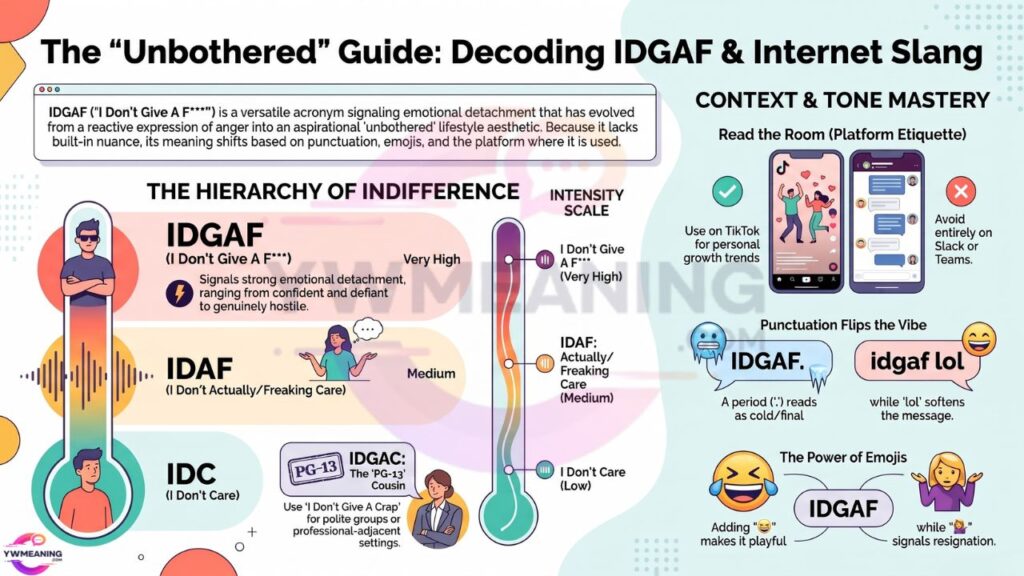
IDGAF stands for “I Don’t Give A F*”** — it’s a blunt way of saying someone feels zero concern, zero interest, or complete indifference toward a situation, comment, or outcome. It’s not subtle. People use it when they want to make it very clear they’re unbothered, whether that’s about criticism, drama, or just a decision they don’t care about.
In plain terms: IDGAF → signals → strong emotional detachment, and depending on who’s saying it, that detachment can read as confident, defensive, sarcastic, or genuinely hostile. That’s the tricky part — the letters stay the same but the vibe changes constantly.
Where Did IDGAF Actually Come From?
This is where most competitor articles kind of skip over things, honestly, but it matters. IDGAF didn’t just appear out of nowhere on TikTok. The full phrase “I don’t give a f***” has roots going back decades in casual American English speech, and it got shortened into acronym form as texting culture exploded in the early-to-mid 2000s alongside cousins like IDK and LOL.
It picked up serious momentum in the 2010s through hip-hop and pop lyrics, brand slogans, and Instagram captions where the “unbothered” attitude became something people actively wanted to project. Then TikTok’s “glow-up” and self-confidence content trends in the early 2020s basically supercharged it — suddenly IDGAF wasn’t just a throwaway line, it became a whole personality aesthetic. That’s a big reason IDGAF → is now associated with → confidence and defiance, not only anger. The tone shifted over time from purely reactive (said in anger) to aspirational (said as a lifestyle statement).
The Emotional Layers Behind IDGAF
IDGAF isn’t a one-note word, which is honestly why so many people misread it. There’s usually one of three emotional layers driving it:
- Defiance — pushing back against criticism or judgment without engaging further
- Emotional detachment — signaling that something genuinely stopped mattering
- Confidence — projecting an “I’m unbothered” energy, sometimes for show
None of these are wrong, but they land really differently depending on context, tone of the conversation, and honestly the relationship between the people texting. A friend teasing you about your outfit choice is a totally different situation than a partner asking why you didn’t reply for two days, but the same four letters could technically answer both. That’s kind of the whole problem with the word — it does a lot of emotional lifting with almost no nuance built in, so the reader has to fill in the gaps using whatever context clues are available (past conversations, emojis, punctuation, even how fast you replied).
There’s also a fourth layer that doesn’t get talked about enough: performative detachment, where someone types IDGAF mostly to convince themselves as much as the other person. It’s the texting equivalent of shrugging your shoulders even though inside you’re a little bothered. This is honestly super common in breakup conversations or after an argument, where “IDGAF” is doing more emotional coping work than actual indifference.
IGAF Meaning in Chat
IGAF basically means the exact same thing as IDGAF — “I Give A F***, but I don’t care” or, more commonly, it’s just used as an abbreviated variant of the same “I don’t give a f***” sentiment. It’s a little less common but pops up in the same casual, blunt contexts.
Example: “You don’t like my outfit? IGAF 😎”
So functionally, IGAF → functions as → a shorthand variant of IDGAF, and most people use them interchangeably without much distinction.
IDGAC Meaning in Text
IDGAC stands for “I Don’t Give A Crap” or “I Don’t Give A Care.” Think of it as the PG-13 cousin of IDGAF — same indifferent energy, but without the profanity, which makes it safer for group chats where explicit language isn’t really the vibe.
Example: “They said I can’t go? IDGAC lol”
This is a good pick when you want the same nonchalant tone but you’re texting your mom, a coworker, or literally anyone you’d rather not curse in front of.
IDAF Meaning in Chat
IDAF means “I Don’t Actually Care” or “I Don’t Freaking Care,” depending on who you ask. It sits somewhere between IDC and IDGAF on the intensity scale — noticeably more casual than IDGAF but with a little more punch than a plain “I don’t care.”
Example: “They canceled the movie? IDAF”
People often use IDAF and IGAF kind of interchangeably, so don’t stress too much over picking the “correct” one — context does most of the heavy lifting anyway.
IDC Meaning (And Why It’s Different From IDGAF)
IDC means “I Don’t Care.” It’s the calmest, most neutral member of this whole family — no profanity, no attitude, just plain disinterest.
“Do you want pizza or burgers?” “IDC, whatever’s fine”
Here’s the key distinction that trips people up: IDC → conveys → mild indifference, while IDGAF → conveys → strong, often emotionally charged indifference. Swapping one for the other genuinely changes how a message reads. If someone asks something serious and you reply IDGAF instead of IDC, it can come across way harsher than you meant it to.
| Term | Meaning | Intensity | Best Used With |
|---|---|---|---|
| IDGAF | I Don’t Give A F*** | Very high | Close friends, casual chats |
| IGAF | Same as IDGAF | High | Casual, blunt conversations |
| IDAF | I Don’t Actually/Freaking Care | Medium | Peers, casual settings |
| IDGAC | I Don’t Give A Crap/Care | Low-medium | Mixed or polite groups |
| IDC | I Don’t Care | Low | Anyone, any setting |
What Does IDGAFWABGTSAM Mean?
Okay, this one’s a mouthful. IDGAFWABGTSAM is generally interpreted as an extended, exaggerated version of IDGAF — commonly expanded to something like “I Don’t Give A F***, Why Are You Bringing This Stuff At Me.” It’s not a widely standardized acronym; it’s mostly used as an inside-joke, sarcastic flex among younger internet users who enjoy stacking letters just to be dramatic about how little they care.
It’s not something you’ll see used seriously in most conversations. Think of it as slang cosplay — people type it more for the comedic shock value of a ridiculously long acronym than for actual communication efficiency.
What Does IDGAFWABGTSAM IKWTFIDAWTFIDD Mean?
This extended chain takes the joke even further. Acronym strings like IDGAFWABGTSAM IKWTFIDAWTFIDD are typically community-invented, meme-style expansions (something along the lines of “I know what the f*** I did and what the f*** I’ll do”) that circulate in comment sections and niche group chats. There’s no single “official” dictionary meaning here — it functions more as a chaotic, humor-driven flex than a genuinely useful abbreviation. If you run into it, the safest read is: it’s an exaggerated joke about not caring, stretched out for comedic effect. Don’t take it too literally.
IDGAFer Meaning in Chat
“IDGAFer” isn’t a standalone acronym — it’s the noun form people create by tacking “-er” onto IDGAF, the same way “hater” comes from “hate.” An IDGAFer basically describes a person who consistently embodies that unbothered, nothing-fazes-me attitude. It’s often used half-jokingly, half-admiringly, like calling someone “a total IDGAFer” to describe their confident, don’t-care personality trait rather than a single moment of indifference.
Example: “Honestly she’s such an IDGAFer, nothing gets to her.”
The IDGAF Gwyneth Paltrow Reference
Every so often, IDGAF gets tied to pop culture moments, and Gwyneth Paltrow has become something of an internet reference point for this — her famously blunt, unapologetic public comments over the years get cited in memes as basically the human embodiment of IDGAF energy. In that context it’s less about the literal acronym and more about projecting unbothered confidence in the face of public criticism.
Nonchalant Meaning in Chat
Nonchalant describes the tone behind a lot of these acronyms — acting casual, relaxed, or indifferent, even in situations where a bigger reaction might be expected. It’s used alongside IGAF, IDC, and IDGAF constantly because it captures the vibe without needing the actual acronym.
Example: “She was totally nonchalant about the drama.”
Basically, nonchalant → describes → the emotional delivery, while IDGAF is one of several tools people use to express it in text.
When Should You Use IDGAF (And When Should You Avoid It)?
This is honestly the part that matters most, because context is everything with a phrase this loaded.
| Context | Okay to Use? | Why |
|---|---|---|
| Texting close friends | Yes | Casual, commonly understood tone |
| Social media comments | Usually | Normal but can come off confrontational |
| Heated arguments | Risky | Can escalate tension fast |
| Workplace chats/emails | No | Too explicit, reads as unprofessional |
| Messaging a partner | Depends | Fine if playful, risky if things are tense |
| Talking to family | Usually not | Easily misread as disrespectful |
A few quick rules of thumb: know your audience before you type it, match the platform (what flies on Snapchat absolutely does not fly on Slack), and read the emotional temperature of the conversation before you drop it in. If you’re not sure, IDC is almost always the safer bet.
How Emojis and Punctuation Change IDGAF’s Tone
Here’s a gap most guides on this topic completely skip, and it’s actually one of the most useful things to understand. The exact same four letters can read completely differently depending on what’s attached to them.
- “IDGAF 😂” — reads as playful, joking, low-stakes
- “IDGAF.” — flat period at the end reads as cold, final, possibly annoyed
- “IDGAF!!” — exclamation points ramp up intensity, can read as defensive or angry
- “idgaf lol” — lowercase plus “lol” softens it into something breezy and casual
- “IDGAF 🤷♀️” — the shrug emoji adds a “whatever happens, happens” resignation
Formatting choices → directly influence → how indifference is perceived by the reader. A period turns a joke into a statement. An emoji turns a harsh line into a laugh. If you’re texting someone who can’t hear your tone of voice, these small details are basically doing the job your voice would normally do — so it’s worth thinking about before you hit send, especially in a sensitive conversation.
Gyat Full Form (And Why People Confuse It With IDGAF Slang)
Since we’re on the topic of confusing internet acronyms, it’s worth clearing this one up too, because people do search for it in the same breath. “Gyat” isn’t actually an acronym at all — it’s slang, generally understood as a stylized, exaggerated version of “goddamn,” typically used (often on TikTok) to react to someone’s appearance, usually their physique. It’s unrelated to the IDGAF family in meaning, but it gets lumped into the same “confusing Gen Z slang” bucket because both terms show up heavily in the same short-form video comment sections and both trip up anyone who isn’t deep in that corner of the internet.
Related Slang Worth Knowing
A few more abbreviations often travel in the same circles as IDGAF:
- IDRC – I Don’t Really Care
- IDK – I Don’t Know
- NGL – Not Gonna Lie
- IDCMB – I Don’t Care Much, Bro
- IDCFS – I Don’t Care For Sure
Knowing these helps you read a chat’s overall tone faster, since they tend to cluster together in the same casual, low-stakes conversations.
How IDGAF Shows Up Differently Across Platforms
Not every app treats this phrase the same way, and that’s actually a pretty important thing to notice.
Instagram and WhatsApp — shows up in captions, story replies, and casual banter, usually read as confident or a little sassy rather than hostile.
Snapchat — pops up in streak chats or private, dramatic conversations, often used jokingly between close friends.
TikTok — heavily tied to “unbothered era” storytelling videos and glow-up content, where it’s basically shorthand for personal growth and moving on from drama.
Facebook and Marketplace — this is where it gets rougher, showing up in arguments, comment-section fights, and buyer/seller disputes where tone is already tense.
Workplace apps like Slack or Teams — avoid it completely here. It reads as aggressive, unprofessional, and honestly can come back to bite you if a manager sees it.
E-commerce reviews — this one’s a little different since it’s often not even about attitude toward a person. People use IDGAF in reviews to express frustration with packaging, delivery, or customer service, like “IDGAF about the box being dented, the product itself works fine.” In this context it’s less confrontational and more just a quick way to separate a minor complaint from the actual verdict on the product.
So really, platform context → shapes → how harsh or harmless IDGAF sounds, and that’s probably the single biggest thing people get wrong when they copy a tone from one app straight into another.
Quick FAQ
Q1: Is IDGAF rude?
It can be — it’s strong, blunt language, so tone and context matter a lot before sending it.
Q2: Is IDGAF the same as IDC?
No, IDC is milder and more neutral, while IDGAF carries stronger, more emotional indifference.
Q3: What’s a softer alternative to IDGAF?
Try IDC, IDAF, or simply saying “it doesn’t really matter to me” instead.
Q4: Can IDGAF be used positively?
Yes — it’s often used to project confidence, self-assurance, or an “unbothered” attitude, not just anger.
Final Thoughts
At the end of the day, IDGAF is one of those acronyms that says a lot in four letters, but exactly what it says depends heavily on who’s typing it, where, and how. Whether you’re dealing with IGAF, IDGAC, IDAF, or the full-blown chaos of IDGAFWABGTSAM, the underlying theme is the same — indifference, dialed up or down depending on the moment. Read the room, watch your punctuation, and you’ll probably use it right.