

Ever opened a text message, Instagram DM, or Snapchat chat and seen someone type “CYA”? If so, you might have wondered whether it was a casual goodbye, a slang term, or something completely different. The truth is that CYA meaning in text can vary depending on the situation, which is why so many people search for what does CYA mean in text, what does CYA mean on text, and whats CYA mean online.
Modern communication moves fast. People use abbreviations, internet slang, and texting shortcuts to save time and make conversations feel more natural. While some acronyms are easy to understand, others can have multiple meanings. That’s exactly the case with CYA. In most digital conversations, it simply means “See Ya.” However, in professional settings, it can carry a very different meaning.
This guide explains everything you need to know about CYA text meaning, where it came from, how people use it today, and how to avoid misunderstandings in different situations.
What Does CYA Mean in Text?
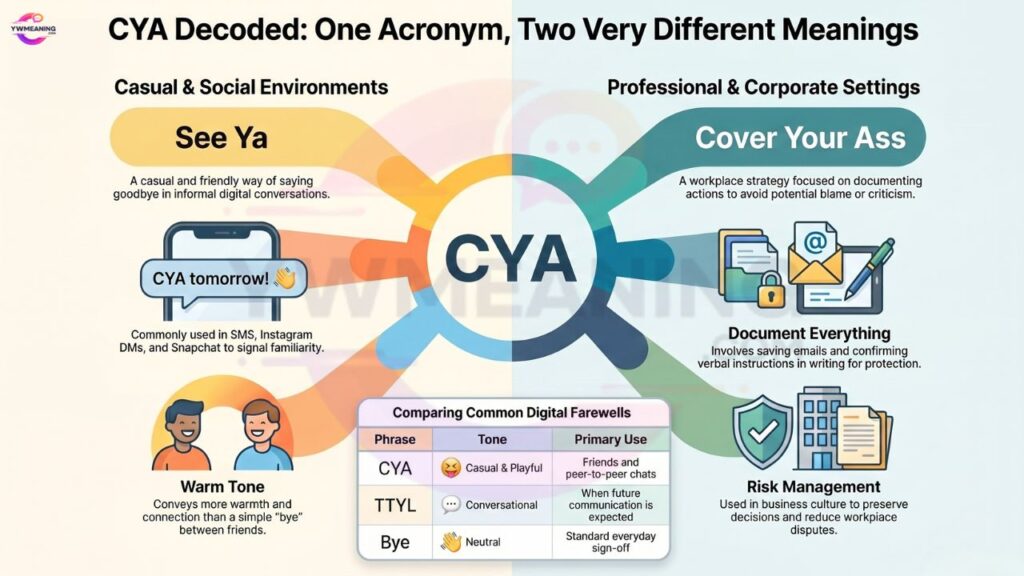
CYA usually stands for “See Ya.”
It is a casual and friendly way of saying goodbye. Instead of typing a full phrase like “See you later,” people shorten it to CYA when texting friends, family members, classmates, or coworkers in informal conversations.
For example:
- “I’m heading home now. CYA tomorrow!”
- “Thanks for hanging out. CYA later.”
- “Movie starts at 8. CYA there!”
In these examples, CYA functions as a simple farewell. The tone is relaxed, friendly, and conversational.
Many users searching for what does CYA mean in text are surprised to learn that it isn’t always a goodbye. Context plays a huge role in determining its meaning.
CYA Full Form and Alternative Meaning
The most common CYA full form is:
CYA = See Ya
However, there is another widely recognized meaning:
CYA = Cover Your Ass
This version is commonly used in workplace communication, office slang, and corporate culture.
When someone says:
“Make sure you save that email. CYA.”
They are not saying goodbye. Instead, they’re advising you to protect yourself by keeping records or documentation in case questions arise later.
This creates one of the most interesting aspects of the term:
CYA → can mean → “See Ya”
CYA → can also mean → “Cover Your Ass”
The intended meaning depends entirely on the context of the conversation.
The Origin of CYA in Text Messaging
The history of CYA goes back to the early days of SMS messaging.
When mobile phones first became popular, text messages had strict character limits. Because users had limited space, abbreviations became extremely common. People shortened words and phrases whenever possible.
Some popular examples included:
| Abbreviation | Meaning |
|---|---|
| LOL | Laugh Out Loud |
| BRB | Be Right Back |
| TTYL | Talk To You Later |
| L8R | Later |
| GR8 | Great |
| CU | See You |
| CYA | See Ya |
Over time, these abbreviations became part of internet slang and digital communication culture.
The workplace version of CYA developed separately through business and corporate environments. Employees often used it to describe actions taken to avoid blame or document decisions.
How CYA Is Used in Everyday Text Messages
In daily texting, CYA almost always means “See Ya.”
You’ll commonly see it used:
- Between friends
- In group chats
- After school conversations
- During online gaming chats
- In social media messages
- In casual workplace conversations
Examples:
- “I’m logging off now. CYA tomorrow.”
- “Class is over. CYA after lunch.”
- “Thanks for helping me study. CYA soon.”
- “Party starts at 7. CYA there.”
Because it feels informal and friendly, many people prefer it over a simple “bye.”
What Does CYA Mean on Text Compared to Other Goodbyes?
Direct answer: CYA means “See Ya” and serves as a casual farewell.
However, it carries a slightly different tone than other goodbye expressions.
| Phrase | Tone | Common Use |
|---|---|---|
| Bye | Neutral | Everyday conversations |
| See You Later | Friendly | Future meeting expected |
| CYA | Casual & playful | Texting and online chats |
| TTYL | Conversational | Future communication |
| Later | Relaxed | Friends and peers |
The subtle difference is that CYA often sounds warmer and more conversational than simply saying “bye.”
People often use it when they expect to talk or meet again soon.
CYA Meaning in Instagram Messages
The CYA meaning in Instagram is almost always “See Ya.”
Instagram users frequently use abbreviations because direct messages are designed for quick conversations. When someone ends a DM with “CYA,” they’re typically saying goodbye in a casual way.
Examples:
- “Thanks for the recommendation. CYA later.”
- “Going offline now. CYA tomorrow.”
- “Good chatting with you. CYA soon.”
Instagram conversations tend to mirror texting habits, so the meaning remains consistent across platforms.
CYA Meaning in Snapchat
The CYA meaning in Snapchat is also “See Ya.”
Snapchat users, especially younger audiences, often rely on short acronyms and abbreviations. Since messages disappear and communication is fast-paced, shortened expressions fit naturally into the platform.
Common Snapchat examples include:
- “Gotta go. CYA.”
- “School tomorrow. CYA then.”
- “Talk later. CYA.”
Because Snapchat culture values speed and simplicity, CYA remains a popular shorthand farewell.
CYA Meaning in Text From a Guy

Many people specifically search for CYA meaning in text from a guy because they wonder whether it carries a hidden message.
In most cases, it doesn’t.
When a guy says:
- “CYA tomorrow.”
- “CYA later.”
- “Okay, CYA.”
He’s usually just saying goodbye.
The phrase itself isn’t inherently romantic, flirtatious, or negative. Instead, the emotional meaning depends on the overall conversation.
For example:
- Friendly conversation → friendly goodbye.
- Flirty conversation → possibly a playful farewell.
- Professional conversation → simple sign-off.
It’s important to evaluate the entire interaction rather than focusing only on the acronym.
CYA Meaning in Business and Workplace Communication
The CYA meaning in business often shifts from “See Ya” to “Cover Your Ass.”
This workplace expression refers to taking precautions that protect you from potential criticism, blame, or misunderstandings.
Examples include:
- Saving important emails.
- Documenting meetings.
- Confirming verbal instructions in writing.
- Keeping records of project decisions.
For example:
“Send a follow-up email to CYA.”
In this situation, the person is recommending that you create documentation that proves what was discussed.
This usage is deeply connected to corporate culture and risk management.
Why Workplace Documentation Matters
Documentation helps:
- Prevent misunderstandings.
- Clarify responsibilities.
- Preserve important decisions.
- Protect employees and organizations.
- Reduce workplace disputes.
That’s why the phrase remains common in professional environments.
Emotional Meaning Behind CYA
Language often communicates more than literal definitions.
When CYA means “See Ya,” it usually conveys:
- Familiarity
- Comfort
- Friendliness
- Informality
- Connection
The sender feels comfortable enough to use casual language.
When CYA means “Cover Your Ass,” it communicates:
- Caution
- Responsibility
- Awareness
- Professional protection
- Practical thinking
Same acronym. Completely different emotional tone.
That’s why context is everything.
Why Context Determines the Correct Meaning
One of the biggest mistakes people make is assuming every acronym has only one meaning.
With CYA, context determines interpretation.
Consider these examples:
“Okay, heading home. CYA tomorrow.”
Meaning: See Ya.
“Make sure you save that contract. CYA.”
Meaning: Cover Your Ass.
“Thanks for the help. CYA later.”
Meaning: See Ya.
“Document every client request. It’s important for CYA.”
Meaning: Cover Your Ass.
Understanding context helps prevent confusion and improves digital literacy.
Related Acronyms and Texting Slang
CYA belongs to a larger family of texting abbreviations.
Some related terms include:
- LOL — Laugh Out Loud
- BRB — Be Right Back
- TTYL — Talk To You Later
- CU — See You
- L8R — Later
- GR8 — Great
- IMO — In My Opinion
- IDK — I Don’t Know
- TBH — To Be Honest
These abbreviations became popular because texting abbreviations make communication faster and easier.
CYA vs TTYL
Although both are friendly, they emphasize different things.
- CYA focuses on seeing someone again.
- TTYL focuses on talking again.
For example:
“CYA tomorrow.”
means you’ll probably meet.
“TTYL.”
means you’ll likely communicate later.
Is CYA Still Popular in 2026?
Yes, although texting habits continue to evolve.
Modern users often switch between:
- CYA
- CU
- Later
- Bye
- Peace
- Catch you later
Gen Z users may use newer expressions, but CYA remains widely understood across age groups.
One reason for its longevity is simplicity. The abbreviation is easy to type, easy to recognize, and instantly understood by most English speakers.
Generational Differences in CYA Usage
Different generations use texting slang differently.
Gen Z
Gen Z tends to favor platform-specific slang and trending phrases. However, most still recognize CYA instantly.
Millennials
Millennials grew up during the rise of SMS messaging. Many continue using classic abbreviations such as CYA, LOL, and BRB.
Gen X
Gen X users understand CYA but may use it less frequently than younger generations.
The result is that CYA remains one of the few acronyms that bridges multiple generations.
Platform-Specific Usage of CYA
Different platforms encourage different communication styles.
Text Messages
CYA primarily means “See Ya” and functions as a farewell.
Used similarly to traditional SMS conversations.
Appears in direct messages and comments as a casual goodbye.
Snapchat
Popular among younger users due to its short-form communication style.
Discord
Often appears in gaming communities when users leave a chat or voice channel.
Slack and Microsoft Teams
May occasionally mean “See Ya,” but business users are more likely to recognize the “Cover Your Ass” interpretation.
Common Misunderstandings About CYA
Many misconceptions surround the acronym.
Myth 1: CYA Is Rude
False.
Most people use it as a friendly farewell.
Myth 2: It Always Means Cover Your Ass
False.
In texting, “See Ya” is usually the intended meaning.
Myth 3: It’s Outdated
Not really.
Although newer slang appears constantly, CYA remains widely recognized.
Myth 4: It’s Formal
Definitely not.
The “See Ya” version is informal and should not be used in formal writing.
CYA Meaning in Text in Urdu
For Urdu speakers searching for CYA meaning in text in Urdu, the phrase usually translates to:
“پھر ملتے ہیں”
or
“بعد میں ملتے ہیں”
When used as “See Ya,” it carries the same friendly farewell meaning.
Examples:
- CYA tomorrow = “کل ملتے ہیں”
- CYA later = “بعد میں ملتے ہیں”
The workplace meaning of “Cover Your Ass” is harder to translate directly but generally refers to protecting yourself through proper documentation and records.
CYA Meaning Medical: Does It Mean Something Different?
Yes.
The CYA meaning medical can differ from texting slang entirely.
Medical abbreviations often vary by hospital, specialty, or documentation system. In some healthcare contexts, CYA may represent organization-specific terminology unrelated to “See Ya.”
Because medical abbreviations are highly specialized, healthcare professionals should always interpret them according to their organization’s standards rather than texting definitions.
How to Respond When Someone Says CYA
If someone texts “CYA,” your response can be simple.
Examples:
- “CYA!”
- “See you then!”
- “Talk later!”
- “Have a good one!”
- “Looking forward to it.”
The best response depends on your relationship with the sender and the tone of the conversation.
Why Understanding CYA Matters in Digital Communication
Some people assume slang terms are unimportant. Actually, understanding them improves communication.
Benefits include:
- Better digital literacy.
- Fewer misunderstandings.
- Stronger communication skills.
- More confidence in conversations.
- Improved understanding of online culture.
As digital communication continues evolving, knowing common abbreviations helps you stay connected and informed.
What About Whit Meaning?
Some users searching for CYA also search for whit meaning.
The word “whit” is not directly related to CYA. A whit refers to a very small amount or tiny degree of something.
Example:
“I don’t care a whit.”
It means the person doesn’t care at all.
Because internet searches often group language-related questions together, users sometimes encounter both terms while exploring texting vocabulary and English expressions.
Final Thoughts
Understanding CYA meaning in text is easier once you know the context. In most conversations, CYA simply means “See Ya,” a casual and friendly goodbye used in text messages, social media chats, and online conversations.
However, the acronym also has a professional meaning: “Cover Your Ass.” In business settings, it refers to protecting yourself through documentation, written records, and careful communication.
Whether you encounter CYA on Instagram, Snapchat, WhatsApp, Discord, or in workplace discussions, the surrounding conversation usually makes the intended meaning clear. Learning these nuances helps you interpret messages correctly and communicate with greater confidence in today’s digital world.
Frequently Asked Questions
What does CYA mean in text?
CYA usually means “See Ya.” It is an informal way of saying goodbye in text messages, social media chats, and online conversations. Most people use it when ending a conversation and expecting to speak or meet again later.
What does CYA mean on text from a guy?
In most situations, CYA from a guy simply means “See Ya.” The phrase itself is not inherently romantic or flirtatious. The overall conversation and tone determine whether there is any deeper meaning behind the message.
What is the CYA meaning in business?
In business environments, CYA commonly means “Cover Your Ass.” It refers to protecting yourself through documentation, emails, records, and written confirmations that help prevent misunderstandings or misplaced blame.
Is CYA still used in 2026?
Yes. Although newer slang terms continue appearing, CYA remains widely recognized across texting, Instagram, Snapchat, WhatsApp, Discord, and other communication platforms. Its simplicity and familiarity have helped it remain relevant over the years.